Most bakery equipment lists you will find are shopping lists. What a new baker actually needs is a sequence: what to buy on day one, what to buy when the orders start repeating, and what to leave alone until volume justifies it.
The prices below are indicative bands for the Indian market and move constantly. Check current rates before you commit to anything. The order of purchase is the part that holds.
The rule for deciding
Before any purchase, an item has to pass one of two tests. Either it removes a failure mode, meaning without it you will regularly produce something you cannot sell. Or it buys back hours, and the arithmetic on that is simple:
Orders to pay it back = price ÷ (hours saved per order × your hourly rate)
A stand mixer at ₹18,000 that saves you 40 minutes per order, valued at ₹150 an hour, saves ₹100 an order. That is 180 orders. At eight orders a week it pays for itself in roughly five months, and everything after that is margin.
Run that on anything you are tempted by. Most of the things bakers regret buying fail it badly, and a few of the things they put off buying pass it in under two months. If you have not set your own hourly rate yet, our guide to pricing cakes so you actually make money works through it.
Stage one: day one
This is the list without which you cannot reliably deliver a cake someone paid for. Nothing here is optional and nothing here is expensive.
| Item | Indicative band | Why it is on the day one list |
|---|---|---|
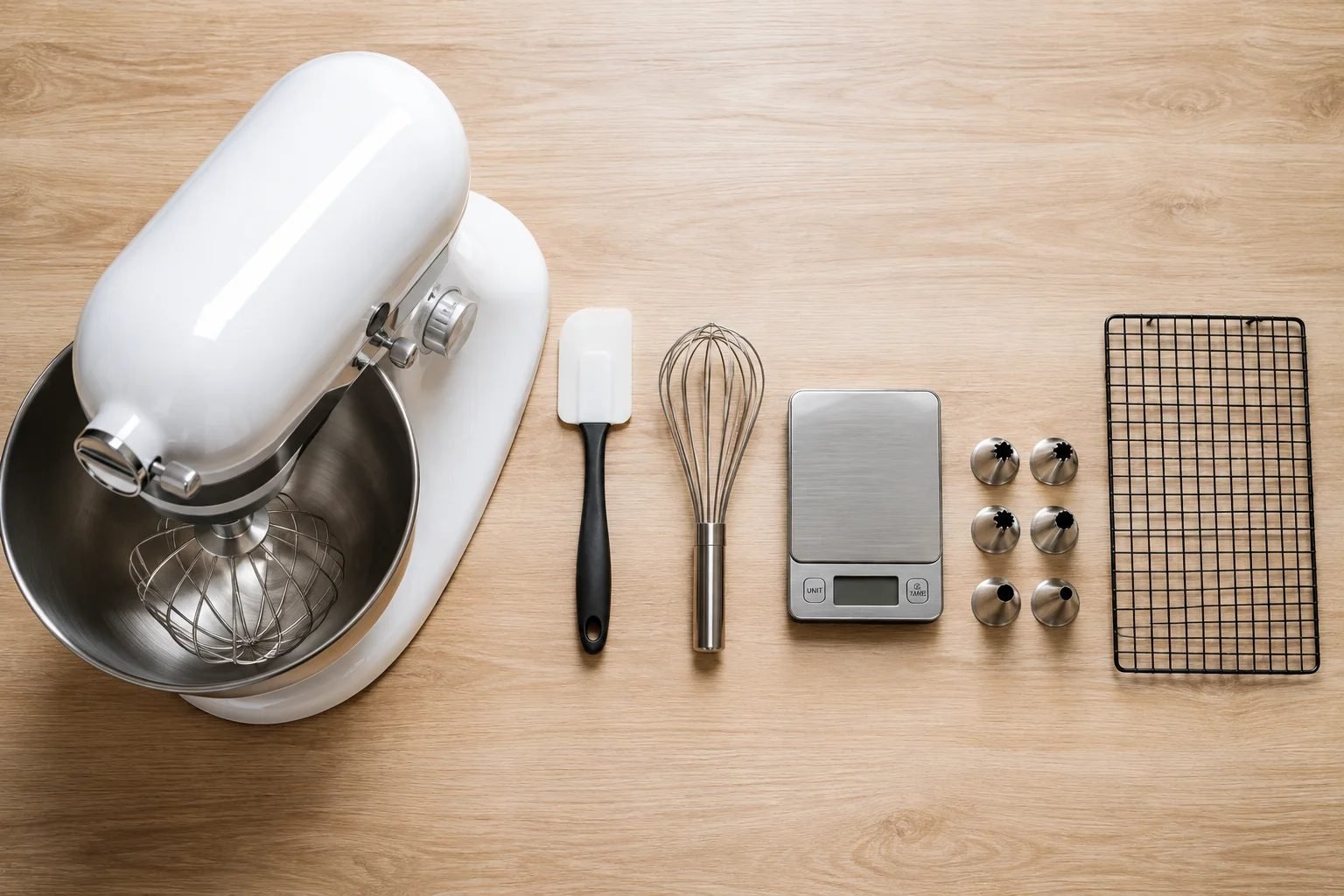
| Digital kitchen scale, 1g | ₹600 to ₹1,500 | Ends cup measurement error, which is the biggest cause of inconsistency |
| Oven thermometer | ₹300 to ₹800 | The highest value item on this entire page |
| OTG, 40 to 60 litre | ₹7,000 to ₹16,000 | Your production capacity |
| Hand mixer | ₹1,200 to ₹3,000 | Whipping cream by hand is not viable at order volume |
| Two aluminium tins, 6″ and 8″ | ₹400 to ₹900 | Your two commonest cake sizes |
| Steel bowls, three sizes | ₹500 to ₹1,000 | Chill better than plastic, which matters for cream |
| Offset palette knife and spatula | ₹300 to ₹700 | Finish quality, immediately visible to the customer |
| Turntable, basic | ₹400 to ₹1,200 | The difference between a smooth coat and a patchy one |
| Piping bags and 6 to 8 nozzles | ₹500 to ₹1,200 | Star, round and leaf cover nearly everything |
| Cooling rack | ₹300 to ₹600 | A cake cooled on a plate steams itself soggy underneath |
Two notes on that list.
The oven thermometer really is the highest value purchase here. Home OTGs in India routinely run 15 to 25 degrees away from the dial, and the drift changes as the unit ages. Almost every “my cake sank in the middle” and “the top burned before the inside cooked” problem is a thermostat telling a comfortable lie. A ₹400 thermometer diagnoses it in one bake.
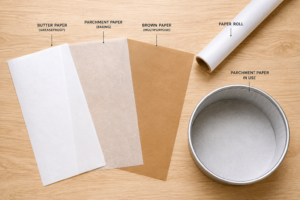
Buy plain aluminium tins, not non-stick. Aluminium conducts more evenly, it is cheaper, and non-stick coating on cheap tins gives up within a year. Line with paper and the sticking problem is solved anyway.
Stage two: around ₹50,000 in total
This is what you buy once orders are repeating and your bottleneck has shifted from “can I make it” to “can I make enough of it”.
Planetary stand mixer, ₹12,000 to ₹35,000. The single biggest jump in what you can take on. It runs while you do something else, which is the only real way to increase output without hiring. Buy a metal gear model if you can. The cheap plastic gear machines fail under bread dough.
A better oven, ₹18,000 to ₹45,000. A fan forced convection oven bakes evenly and lets you run two trays. If bread is a meaningful part of what you sell, a small deck oven is the better spend, because deck heat is what gives bread its crust and lift.
A dedicated refrigerator, ₹15,000 to ₹30,000. Sharing the family fridge stops working the moment you have three orders in a weekend, and cream, ganache and finished cakes all need reliable cold. This also matters for what your whipping cream is capable of.
Jeweller’s scale reading to 0.1g, ₹500 to ₹1,200. Baking powder, soda, gel colours and essences are all dosed in fractions of a gram, and a 1g scale simply cannot see the difference between right and twice as much.
Matched tin sets and half sheet pans, ₹3,000 to ₹8,000. Matched means the same depth, so two layers bake in the same time.
A heavy ball bearing turntable, acrylic smoothers, bench scraper, ₹2,000 to ₹5,000. Finish tools. They look cosmetic and they are the difference between an order that gets photographed and one that does not.
Stage three: around ₹2 lakh
At this point you are not buying tools, you are buying throughput, and the decisions get less about baking and more about business.
The usual shape of it: a commercial deck or rotary oven, a 10 to 20 litre planetary mixer, a spiral mixer if you are doing bread volume, a display chiller if you have a counter, a deep freezer, a proofer, stainless steel work tables and proper exhaust.
Three things people underestimate at this stage. Electrical load, because a deck oven and a chiller together will exceed a domestic connection and you may need a three phase supply. Floor space, because commercial equipment needs clearance around it that showroom photos never show. And licensing, because operating at this scale is a different regulatory position from baking at home, covering premises, registration and record keeping.
None of that is a reason not to grow. It is a reason to price the whole move rather than just the oven. Our breakdown of what it actually costs to start a home baking business covers the earlier stages, and the same logic applies here with bigger numbers.
What not to buy first
The list of things bakers buy early and use twice is remarkably consistent.
- A 40 or 60 piece nozzle set. You will use six of them. Buy those six in a better quality.
- Novelty and character tins. One order, then a cupboard.
- An airbrush kit. Genuinely useful, at a level of decorating volume most people reach much later.
- Large silicone mould collections. Buy the mould when you have the order.
- Fondant tool kits. Only if fondant work is actually what you sell. Most Indian orders are cream finished.
- A second hand commercial oven with no service history. The saving disappears the first time the thermostat goes.
The oven question
| Type | Good for | Weak at |
|---|---|---|
| Convection microwave | Very small batches, tiny kitchens | Cavity size, even browning, anything past one tin |
| OTG 40 to 60L | Starting out, cakes, cookies | Hot spots, slow recovery, one tray at a time |
| Fan convection oven | Even bakes, two or three trays | Drying out delicate sponges if the fan is not adjustable |
| Deck oven | Bread, pizza, crust and lift | Cost, weight, electrical load |
If you are choosing one oven and you sell mostly cakes, the fan convection oven is the safer buy. If bread is more than a third of your output, go to a deck.
Common questions
What equipment do I need to start a bakery from home?
On day one: a digital scale, an oven thermometer, a 40 to 60 litre OTG, a hand mixer, two aluminium tins, steel bowls, an offset palette knife, a basic turntable, piping bags with six to eight nozzles, and a cooling rack. That covers everything needed to deliver a cake someone paid for.
How much does bakery equipment cost in India?
A starting kit lands between ₹25,000 and ₹40,000 including the oven. Stepping up to a stand mixer, a convection oven and a dedicated fridge takes the total to roughly ₹75,000 to ₹1.2 lakh. A small commercial setup starts around ₹2.5 lakh. Prices move constantly, so treat these as bands rather than quotes.
Is an OTG or a convection oven better for baking?
An OTG is the sensible starting oven: cheaper, simple, fine for cakes and cookies, but it bakes one tray at a time and has hot spots. A fan convection oven bakes more evenly and takes two or three trays, which is the upgrade that increases output. If bread is more than a third of what you sell, skip both and go to a deck oven.
Do I really need a stand mixer?
Not on day one, and yes fairly soon after. Run the payback: price divided by the hours it saves per order multiplied by your hourly rate. A ₹18,000 mixer saving 40 minutes an order at ₹150 an hour pays back in about 180 orders, which is five months at eight orders a week.
What is the single most useful tool for a beginner?
An oven thermometer, at around ₹400. Home OTGs in India routinely run 15 to 25 degrees away from the dial, and most sunken middles and burnt tops trace straight back to that. It is the cheapest item on the list and the one that fixes the most problems.
Five things to do this week
- Put a thermometer in your oven and bake nothing. Compare the reading to the dial at 180. Write the offset on a sticker on the door.
- Run the payback formula on the one item you have been thinking about for a month. The number decides it, not the wanting.
- Time yourself on the step you do most. That is where a machine will actually pay you back.
- Count how many of your existing tools you used in the last thirty days. It is usually about a third of them.
- Before the next upgrade, check whether your packaging and cold chain can keep up with more output. Making more cakes than you can deliver intact is not progress. Our note on cake packaging that survives a summer delivery covers that side.
Equipment does not make a baker better. It makes a good baker faster and a consistent baker more consistent, which is worth a great deal, but only in that order.
Ivykart supplies these ingredients wholesale to bakeries and home bakers across India, with a GST invoice on every order. Sign up in the app with your phone number and order in minutes. Questions: 8801348400 or care@ivykart.com.
Prices quoted are indicative market bands and change frequently. The note on licensing and premises is general information, not legal advice, and requirements vary by state and by scale. Confirm your position with the relevant authority or a qualified professional before acting on it.