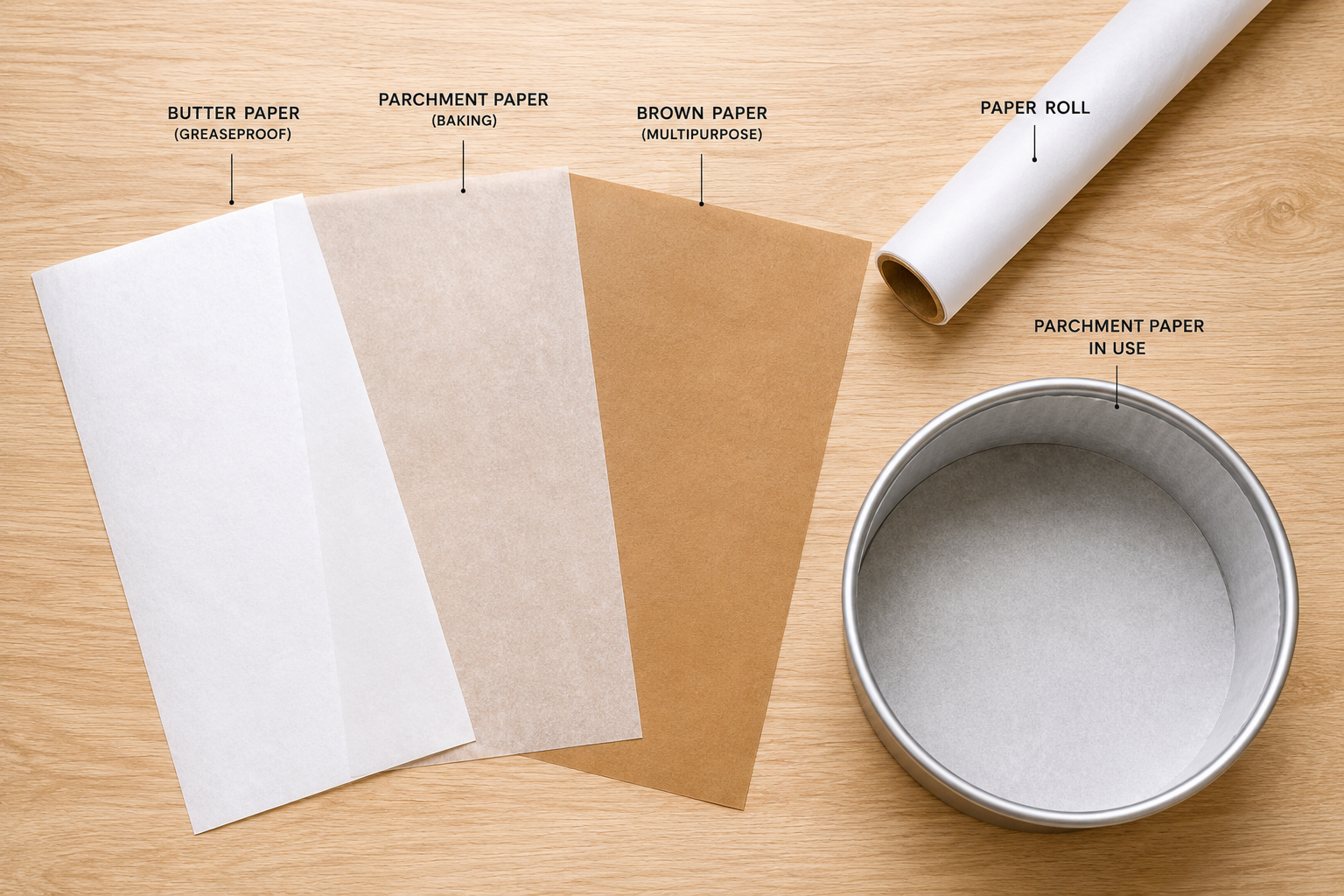
In most Indian kitchens, butter paper, parchment paper and baking paper are three names for whatever roll is in the drawer. Two of those three are genuinely different products, and one of them should never go near an oven at all.
If your cake keeps sticking to a paper that was supposed to be non-stick, or a sheet has ever browned and gone brittle at 200 degrees, this is the reason.
The short answer
| Paper | What it is | Truly non-stick? | Oven safe? |
|---|---|---|---|
| Greaseproof (usually sold as butter paper) | Pulp beaten until the fibres pack densely enough to block oil | No, resists grease only | Yes, but browns and embrittles at high heat |
| Parchment / baking paper | Paper with a silicone coating, or acid treated vegetable parchment | Yes | Yes, typically to about 220 to 230°C |
| Wax paper | Paper coated in paraffin wax | Slippery when cold only | No. Never. |
The problem is that in India all three are commonly sold as “butter paper”. What you get from a general store under that name is most often plain greaseproof, occasionally wax coated, and only sometimes actually silicone parchment. The label rarely tells you.
How to tell what you have
Three tests, in ascending order of certainty.
The feel test. Silicone parchment is slightly slick on both faces and stays that way. Greaseproof feels like ordinary paper, smooth but dry. Wax paper feels faintly waxy and slightly cool.
The fingernail test. Scrape firmly with a nail. Wax paper gives up a fine white flake of paraffin. Parchment and greaseproof do not.
The oven test, which settles it. Put a scrap in the oven at 180 degrees for ten minutes. Parchment comes out looking almost unchanged. Greaseproof goes tan and brittle. Wax paper melts, smells and smokes. Do this once with a new supplier rather than finding out on an order.
What each one is actually for
Greaseproof, the everyday butter paper. Wrapping. Roti and paratha stacks, sandwiches, burgers, pastries handed across a counter, layering between biscuits in a tin. It is also fine as a general oven liner at moderate temperatures if you grease it, which many bakers do without realising it is not doing the job on its own.
Parchment. Lining tins and trays, piping cornets, rolling out dough between two sheets, holding delicate things you need to lift. This is the one worth paying for when a bake actually has to release cleanly.
Wax paper. Cold work only. Separating chilled dough discs, layering fudge and barfi, wrapping things going into the fridge. It has real uses. None of them involve heat.
Silicone mats sit alongside all three. Higher heat tolerance, reusable for hundreds of bakes, better for cookies where you want a flat even base. The upfront cost is higher and they are worth it on trays you use daily.
Heat, and the part that is a safety issue
Wax paper in an OTG is not a technique mistake, it is a smoke and fire risk. Paraffin melts well below baking temperature, soaks into the paper, and paper soaked in melted wax near a heating element is exactly what it sounds like.
Parchment has real limits too. Most is rated to around 220 to 230 degrees. Above that it darkens and eventually chars. It should never touch or hang near the element, which is easy to get wrong in a small OTG where an oversized sheet curls up at the edges. Trim it to the tin.
In a microwave, parchment is fine. Greaseproof is fine. Wax paper is best kept out, and anything with metallic printing must never go in.
Is butter paper edible?
No. None of these are food, and none of them should be served with the product. A small piece swallowed accidentally is not a poisoning event, but that is a very different statement from it being safe to eat.
The practical version for a bakery: peel the liner off the base before the cake goes on the board. A customer finding paper stuck under their slice reads as carelessness, whatever the truth of it, and it is one of the more common complaints on delivered cakes.
Lining a tin so it actually releases
- Grease the tin under the paper, not just the paper. A thin film of butter or oil holds the liner flat against the metal. A loose liner creases, and every crease prints itself into the side of the cake.
- Round tins: a base circle plus a collar strip cut about 2cm taller than the tin. The collar is what saves the sides.
- Loaf tins: one long strip running base to base with the ends hanging over as handles. You lift the loaf straight out instead of turning it over and cracking the top.
- Chiffon and angel cakes are the exception. These need to grip an ungreased, unlined side to climb. Line the base only, and leave the walls bare.
- Sheet pans: crumple the parchment into a ball first, then flatten it. It sits into the corners instead of fighting you.
Can you bake without it?
Often, yes. Grease the tin thoroughly and dust with maida, tapping out the excess, or with cocoa for a chocolate cake so you do not get a white bloom on the crust. A proper release spray does the same job faster.
Where that approach fails: high sugar batters and anything with fruit, jam or caramel touching the tin, because sugar welds itself to metal. For those, line it. The five rupees of paper is cheaper than the cake.
Rolls, sheets or pre-cut circles
This is where a bakery quietly loses money, because the cheapest looking option is often not the cheapest option.
A worked example, using indicative rates. Run it again with your own.
A 20 metre roll, 30cm wide, yields roughly 95 circles of 8 inch. At ₹280 a roll that is about ₹2.95 a circle. But cutting 95 circles takes around 25 minutes, and at ₹150 an hour that is another ₹0.65 a circle. Real cost, roughly ₹3.60.
Pre-cut 8 inch parchment circles bought by the hundred land closer to ₹1.50 each, with no cutting time at all.
| Cut from a roll | Pre-cut circles | |
|---|---|---|
| Material per circle | ₹2.95 | ₹1.50 |
| Your time per circle | ₹0.65 | ₹0 |
| Real cost | ₹3.60 | ₹1.50 |
For the two or three sizes you bake every week, pre-cut wins on both money and hours. Keep a roll for odd sizes, sheet pans, collars and piping cornets, where cutting is unavoidable anyway. It is the same logic that applies to buying boxes and boards in quantity, and it is one of the costs that quietly disappears from most cake pricing.
Storing it
Paper is hygroscopic and Indian storerooms are humid. Greaseproof goes limp and starts to tear when handled. Silicone parchment holds up much better but the roll edges will still swell and jam in the box.
Keep rolls in their sleeves, standing upright or flat on a shelf, off the floor and away from the wall that gets damp in monsoon. The same discipline that protects your ingredients through Indian humidity applies here, and paper is cheap enough that people skip it and then wonder why half a roll is unusable.
Common questions
Is parchment paper the same as butter paper?
Usually not. Parchment is silicone coated and genuinely non-stick. What is sold in India as butter paper is most often plain greaseproof paper, which resists oil but is not non-stick, and is occasionally wax coated, which must never go in an oven. The names are used interchangeably even though the products are different.
Is butter paper the same as baking paper?
Baking paper normally means silicone coated parchment. Butter paper normally means greaseproof. They look similar and behave differently, so test a scrap in the oven at 180 degrees for ten minutes before trusting a new roll.
Is butter paper edible?
No. It is not food and should not be eaten or served with the product. A small piece swallowed by accident is not dangerous, but the liner should always be peeled off before a cake goes on its board.
What is butter paper made of?
Greaseproof butter paper is ordinary wood pulp that has been beaten for far longer than usual, so the fibres pack densely enough to block oil from passing through. There is no coating involved, which is exactly why it resists grease without being non-stick.
Can butter paper go in a microwave?
Greaseproof and parchment are both fine in a microwave. Wax paper is best kept out, and anything with metallic printing must never go in.
Can you bake a cake without butter paper?
Often, yes. Grease the tin well and dust it with maida, or with cocoa for a chocolate cake so you avoid a white bloom on the crust. Line it anyway for high sugar batters and anything with fruit, jam or caramel touching the tin, because sugar welds itself to metal.
Five things to do this week
- Run the ten minute oven test on whatever roll is in your kitchen right now. You may not have what you think you have.
- Count how many 8 inch and 6 inch circles you cut in a normal week, and price pre-cut against your roll including your own time.
- Move any wax paper out of the drawer next to the oven. That mix-up happens under time pressure.
- Start greasing the tin under the liner if you are not already. It is a five second change that removes crease marks.
- Check that your liner is being peeled off before the cake goes on the board, every time.
None of this is expensive or difficult. It is just the sort of thing nobody explains, so bakers spend a year quietly fighting the wrong roll of paper.
Ivykart supplies these ingredients wholesale to bakeries and home bakers across India, with a GST invoice on every order. Sign up in the app with your phone number and order in minutes. Questions: 8801348400 or care@ivykart.com.