A cake that arrives leaning, sweating or stuck to the lid is a bad cake, as far as the customer is concerned. It does not matter how it tasted at your counter. Packaging is the last thing most bakers buy and the first thing the customer sees.
In India it is also doing a harder job than packaging almost anywhere else, because it has to hold up in 38 degree heat, monsoon humidity, and a delivery leg that is usually a two wheeler.
There are four parts, not one
People say “cake box” and mean the whole system. It is actually four separate purchases, and each one fails in its own way.
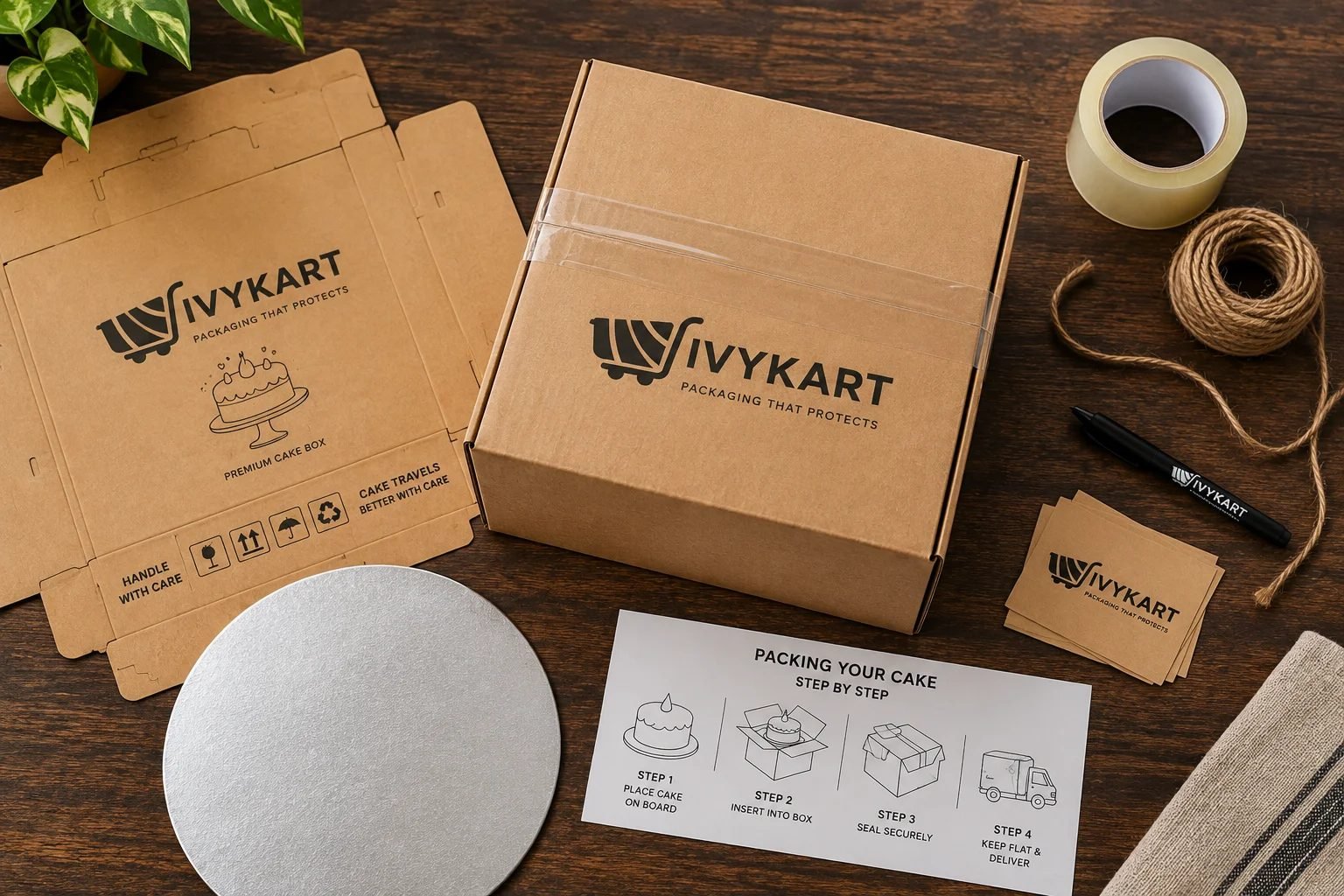
The board or base carries the weight and takes the knife. The box handles heat, crush and rain. The insert stops movement inside the box. The closure, tape, ribbon or sticker, keeps the lid down and tells the customer nobody opened it on the way.
Most delivery damage traces back to the second and third of those, and most bakers spend their packaging budget on the first and fourth.
Boards and bases
The board is the single cheapest place to ruin a cake. A board that flexes lets the cake crack across the middle when someone picks the box up by one corner.
Plain corrugated boards are fine up to about 1kg. Above that, or for anything with layers, you want a laminated or MDF board. For tiered work, the base board should be genuinely rigid, because it is carrying everything above it.
Grease resistance matters more than people expect. An unlaminated board under a buttercream or ganache cake will darken with oil in a couple of hours, and by the time the box is opened it looks like something has leaked.
Sizing, as a starting point. Check these against your own tins rather than trusting a chart, because tin sizes vary.
| Cake | Round tin | Board | Box (inches) |
|---|---|---|---|
| 500g | 6″ | 6″ | 7 x 7 x 5 |
| 1kg | 7 to 8″ | 8″ | 9 x 9 x 5 |
| 1.5kg | 9″ | 9″ | 10 x 10 x 5 |
| 2kg | 10″ | 10″ | 11 x 11 x 6 |
| Tall or two tier | varies | +1″ on base | add 3″ of height |
The height column is the one to get right. A box that is 5 inches tall over a 5 inch cake means the lid is resting on your piping. Buy the taller box.
Box materials, and what fails in heat
Corrugated board is the workhorse. The fluting is a layer of trapped air, which makes it the only common box material that does anything useful thermally. It is also the strongest under stacking. It prints less crisply than duplex, which is the trade off.
Duplex or greyboard prints beautifully, costs less, and is the standard for pastry and cupcake boxes. It has essentially no insulation value and it goes soft in high humidity. Fine for short local deliveries and shop pickup, risky for anything longer.
Transparent PVC and PET boxes sell the cake before it is opened, which is why bento and dessert boxes use them. They are also the worst possible thermal choice. Clear plastic in a car with sun on it becomes a small greenhouse, and the condensation runs straight down onto the cream. Use them for chilled display and short handovers, not for summer delivery.
Windowed boxes split the difference and mostly keep the advantages of both, as long as the window is small.
The humidity problem nobody plans for
Cardboard is hygroscopic. A corrugated box stored through a Kerala or coastal Andhra monsoon can lose a serious share of its stiffness before you ever put a cake in it, and you will not notice until one collapses.
Store flat, off the floor, away from the outside wall, and wrapped in the plastic they came in. Do not store boxes in the same room as your flour if that room runs humid. The same conditions that ruin your ingredients in Indian humidity are quietly ruining your packaging.
A practical test: hold a box by one edge, horizontally. If the far edge droops noticeably, it has taken on moisture and should be used for something that is not travelling.
What actually goes wrong in transit
Four failure modes account for nearly all of it.
Sliding. The cake moves inside the box and hits the wall. Fix it at the base: a small dab of royal icing or a loop of double sided tape between the board and the box floor holds a cake completely still and costs nothing.
Tilting. Two wheeler plus speed breaker. A cake that is stuck down will survive a tilt that a loose one will not. For tall cakes, a centre dowel through the layers is the real answer.
Condensation. A cold cake going into a hot box pulls moisture out of the air onto itself. Let a fridge cold cake sit for eight to ten minutes before boxing, or you are packing water in with it.
Lid contact. Buy height, or use a dome insert. There is no clever technique that saves piping from a lid pressing on it.
Cupcakes, pastries and bento
For these the insert is the product. A six cavity cupcake insert that actually grips the base is the difference between six cupcakes and six cupcakes lying on their sides in a smear of frosting.
Check the cavity diameter against your liners before you buy a hundred. Insert cavities are usually built for a standard liner base of about 5cm, and if you use tulip liners or a wider base they will not sit.
Bento and dessert boxes are the fastest growing format in India right now, and “what is bento cake” is a genuine search in its own right. They are small, they are usually clear or windowed, and they are almost always short distance. That is the format working as intended.
The cold chain, in 20 minute units
Whipped cream in a closed box in an Indian summer has roughly 20 to 40 minutes before it starts to soften, depending on which cream you used. If you are unsure which side of that line your cream sits on, our note on dairy and non-dairy whipping cream covers it.
- Chill the finished cake properly before it goes in the box. A cake that starts at 6 degrees has a far longer window than one that starts at 20.
- If you use an ice pack, put it under the board or outside the box in the carry bag, never loose inside next to the cake. Loose ice packs sweat onto the cream.
- An insulated delivery bag is a one time purchase of a few hundred rupees and does more for summer delivery than any box upgrade.
- Push summer deliveries to before 11am or after 5pm where the customer will allow it. This is free and it works better than everything else on this list.
What packaging actually costs you
Packaging is one of the four costs bakers routinely leave out of their pricing, and it is the easiest one to fix, because it responds directly to buying in quantity.
An illustrative build for a single 1kg cake order. Use your own current rates, the point here is the gap between the two columns.
| Item | Buying in fives | Buying in hundreds |
|---|---|---|
| 8″ laminated cake board | ₹18 | ₹11 |
| 9 x 9 x 5 corrugated box | ₹42 | ₹26 |
| Ribbon and printed label | ₹8 | ₹4 |
| Tape, carry bag, card | ₹12 | ₹7 |
| Per order | ₹80 | ₹48 |
Thirty orders a week at ₹32 saved is around ₹4,100 a month, on packaging you were buying anyway. That is a margin improvement that requires nothing from your customers and no extra hours from you, which is rarer than it sounds. The full picture of where this sits in your numbers is in our guide to pricing cakes properly.
The counterweight is storage. A hundred boxes takes real space, and boxes stored badly in a humid room are boxes you will throw away. Buy in quantity for the sizes you use every week. Buy in fives for the odd sizes.
Common questions
What size box do I need for a 1kg cake?
A 1kg round cake is usually baked in a 7 or 8 inch tin, sits on an 8 inch board, and fits a 9 x 9 x 5 inch box. If the cake is tall or has piping on top, go up in height rather than width, because a lid resting on the decoration is the most common packaging failure.
What is a bento cake?
A bento cake is a small cake, usually 4 inches and around 300 to 400g, served in a compact box like a lunch box. They are designed to be gifted whole to one or two people, they are almost always short distance deliveries, and they are usually packed in clear or windowed boxes so the design shows.
How do I stop a cake sliding around inside the box?
Fix the board to the box floor. A small dab of royal icing or a loop of double sided tape under the board holds a cake completely still through a two wheeler ride and costs nothing. For tall cakes, add a centre dowel through the layers.
Are transparent cake boxes good for delivery?
They sell the cake beautifully and they are the worst thermal choice available. Clear plastic in sunlight becomes a small greenhouse and condensation runs down onto the cream. Use them for chilled display and short handovers, and use corrugated for summer delivery.
How long can a cream cake stay out of the fridge?
In an Indian summer, roughly 20 to 40 minutes in a closed box before it starts to soften, and the figure depends almost entirely on which cream you used. Chilling the cake properly before boxing extends that window more than anything else you can do.
Five things to do this week
- Open a box from your current stock and press down on the lid centre. If it flexes onto where the cake would be, your boxes are too short.
- Stick the next ten cakes to their boxes with a dab of icing or double sided tape and see whether your damage complaints change.
- Count how many box sizes you actually use. Most bakers can consolidate to three or four, which is what makes bulk buying possible.
- Move your box stock off the floor and out of any room that gets steam.
- Add your real per order packaging cost, all four parts, into your price list. Not an estimate. Add it up once.
Good packaging does not win you a customer. Bad packaging loses you one permanently, usually on the order that mattered most to them.
Ivykart supplies these ingredients wholesale to bakeries and home bakers across India, with a GST invoice on every order. Sign up in the app with your phone number and order in minutes. Questions: 8801348400 or care@ivykart.com.