Ask a baker in Coimbatore and a baker in Dehradun which whipping cream they use and you will get two different answers, both correct. Cream is the one ingredient where the right choice depends less on how it tastes and more on the temperature between your kitchen and your customer’s table.
Three quite different products are sold in India under the same word. Getting them mixed up is the single most common reason a cake looks perfect at 11am and looks like it has been rained on by 2pm.
What is actually being sold as cream
Fresh or cooking cream sits at roughly 25 percent milk fat. Amul Fresh Cream and most tetra pack cooking creams are in this bracket. It is made for gravies and coffee, not for piping.
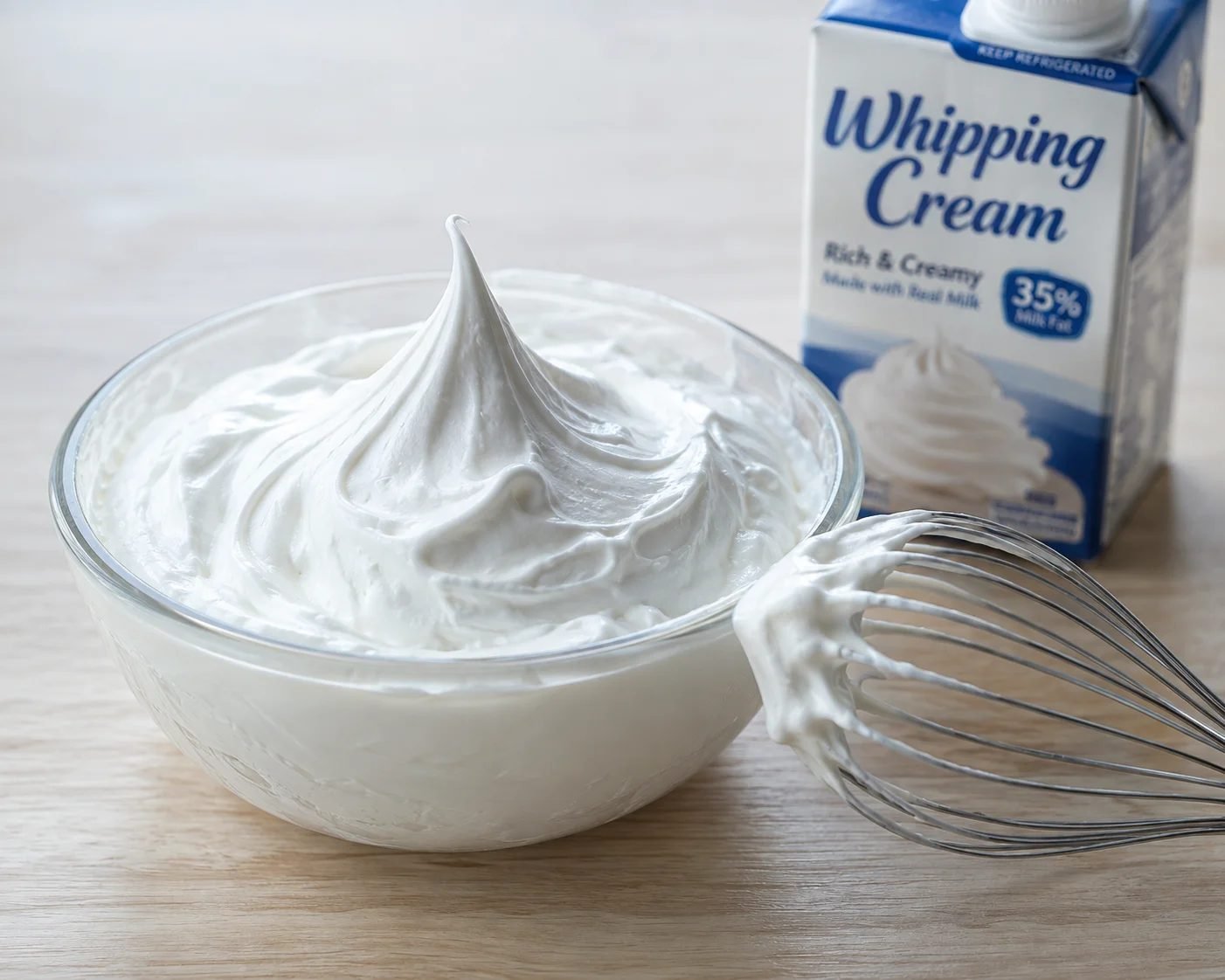
Dairy whipping cream runs 30 to 38 percent milk fat. This is real cream that whips, tastes like cream, and behaves like an unstable chemical experiment once it warms past about 10 degrees.
Non-dairy whipping cream is not cream at all. It is vegetable fat, usually palm or coconut derived, emulsified with water, pre-sweetened and pre-stabilised. Rich’s and Tropolite are the names most Indian bakers will recognise.
| Product | Fat | Whips? | Holds at 32°C | Sweetened |
|---|---|---|---|---|
| Fresh or cooking cream | ~25% | Poorly, if at all | No | No |
| Dairy whipping cream | 30 to 38% | Yes | About 20 minutes | No |
| Non-dairy whipping cream | ~25 to 28% veg fat | Yes, easily | Several hours | Yes, fixed |
Why your Amul fresh cream collapses
Whipping works by getting fat globules to partially coalesce around air bubbles and hold them there. Below about 30 percent fat there is simply not enough fat in the liquid to build that network. You can beat 25 percent cream for twenty minutes and get thick froth that turns back to liquid in half an hour.
The workarounds you will find online, freezing the cream to slush, adding icing sugar, adding a spoon of cornflour, are all attempts to compensate with viscosity for fat that is not there. They sometimes produce something pipeable. They almost never produce something that survives being cut and served an hour later. If you are selling the cake, this is not a risk worth taking.
Dairy whipping cream, and the temperature it demands
Real whipping cream tastes better than anything else in this article. There is no argument to be had there. The price of that flavour is a narrow working window.
The cream should be between 4 and 7 degrees when you start. The bowl and the whisk should be cold too. Above roughly 10 degrees the fat is too soft to hold structure, and what you get is a cream that looks whipped for five minutes and then weeps.
In an air conditioned kitchen at 22 degrees this is completely manageable. In an unconditioned kitchen in Vijayawada in May, where the counter itself is at 34 degrees, you have perhaps 20 minutes of real working time and no margin at all for a delivery that sits in a car.
Dairy is the right choice for cold cabinet display, same day pickup, AC kitchens, and anything where flavour is the selling point. It is the wrong choice for a two hour scooter delivery in summer.
Non-dairy whipping cream, honestly
Most working Indian bakeries run on non-dairy cream, and it is worth being straight about why rather than pretending it is a compromise nobody makes.
What it does well: it whips from a wider temperature range, it holds piped detail for hours, it takes colour cleanly, it does not split if you over-beat it slightly, and it survives transport. It is also more forgiving of an inexperienced hand, which matters when you are training someone.
What it does badly: the sweetness is fixed at the factory and you cannot dial it down, which pushes your whole cake sweeter than you may want. The fat is vegetable, often hydrogenated or palm based, and some palates read it as waxy. It will never taste like dairy.
This is a genuine judgement call, not a right answer. A reasonable position, and the one plenty of good bakeries take, is to use non-dairy for structural work (crumb coats, piped borders, anything that has to hold a shape through a delivery) and dairy or a ganache for the layer the customer actually tastes.
Overrun, the number that changes your costing
Here is what almost nobody factors in. Whipping cream is priced per litre of liquid, but you use it per litre of whipped volume, and the two products expand by very different amounts.
Non-dairy whipping cream typically triples in volume. Good dairy whipping cream roughly doubles. That gap does more to your cost per cake than the shelf price does.
A worked example, using indicative rates. Substitute your own current buying price, because that is the only number that matters for your costing.
| Non-dairy | Dairy 35% | |
|---|---|---|
| Buying price per litre | ₹230 | ₹460 |
| Whipped yield from 1 litre | ~3 litres | ~2 litres |
| Cost per litre of whipped cream | ₹77 | ₹230 |
| Cream for one 1kg cake (about 800ml whipped) | ₹62 | ₹184 |
On the shelf, dairy looks twice the price. In the cake it is closer to three times, because you get half the volume out of it. On a bakery doing thirty cakes a week that difference is roughly ₹3,700 a month, which is not a rounding error.
None of that says dairy is the wrong choice. It says the choice should be made with the real number in front of you rather than the pack price. If you have not put cream through a proper costing yet, our guide to pricing cakes so you actually make money shows where it fits.
Whipping in a 34 degree kitchen
Assume the room is against you and work accordingly.
- Chill the bowl and the whisk for fifteen minutes before you start. A steel bowl in the freezer costs you nothing.
- Take the cream out of the fridge last, not first. Every minute on the counter is working time spent.
- Whip on medium, not maximum. High speed makes big unstable bubbles and takes you from soft peak to grainy in about four seconds.
- Stop at soft peak if you are going to fill and then finish. Stop at firm peak only for piping you are doing immediately.
- If you over-whip dairy cream and it turns grainy, fold in two tablespoons of cold liquid cream by hand. It will usually come back. Non-dairy that has gone grainy is generally finished.
- Work in batches you can use in ten minutes. A large bowl of whipped cream sitting on a hot counter is a bowl of cream getting worse.
Making dairy cream hold when you need it to
If you want dairy flavour and non-dairy stability, you stabilise. The options, cheapest first:
Milk powder. Two tablespoons per 500ml, whisked in dry at the start. Costs almost nothing, adds a little body, no change to flavour. Buys you maybe an extra hour. The least effective and the least trouble.
Gelatin. One teaspoon bloomed in two tablespoons of cold water, melted gently, cooled to just warm, then poured in as the cream reaches soft peak. Genuinely effective. Not vegetarian, which rules it out for a significant share of Indian customers, and you must tell people if you use it.
Agar. The vegetarian answer, and harder to work with, because agar has to actually boil to activate and then sets very quickly as it cools. Get the timing wrong and you get threads of set agar through your cream. Practise it before you use it on an order.
Cream cheese or mascarpone. 100g beaten smooth then folded into 500ml of whipped cream. Excellent stability, excellent flavour, and it changes the product into something slightly tangy, which may or may not be what you wanted.
Commercial cream stabiliser. Does one job and does it reliably. Follow the pack dosage rather than guessing.
Which to use where
- Piped borders, rosettes, anything with edges: non-dairy, every time.
- Crumb coat and final coat on a delivered cake: non-dairy, or stabilised dairy if flavour is the selling point.
- Filling between layers: dairy or stabilised dairy. It is protected by the cake around it.
- Under fondant: ganache, not cream. Cream holds moisture against the fondant and the fondant sweats.
- Ganache and mousse: dairy, at 30 percent or higher. Non-dairy will not emulsify with chocolate properly. There is more on the chocolate side of this in our note on compound versus couverture.
- Cold set desserts sold in cups: either, and non-dairy if they are going into a display cabinet that gets opened all day.
Storage, which is where most of it is wasted
Non-dairy whipping cream is sold frozen and must be thawed in the fridge overnight, not on the counter and never in a microwave. Thawed too fast, the emulsion breaks and it will not whip properly, and there is no fixing it. Once thawed, use it within about a week and do not re-freeze.
Dairy whipping cream lives in the coldest part of the fridge, not the door, and does not freeze well. Whipped dairy cream is a two day product at best.
Both are the first thing to suffer in a power cut, which in most of India is a planning problem rather than a hypothetical. Our guide to storing baking ingredients in Indian humidity covers the rest of the cold chain.
Common questions
Is fresh cream the same as whipping cream?
No. Fresh or cooking cream, including Amul Fresh Cream, sits at about 25 percent milk fat. Whipping cream is 30 to 38 percent. That fat difference is what decides whether the cream can hold air, which is why fresh cream will not whip into anything stable.
Can I use fresh cream instead of whipping cream?
Not for anything that has to hold a shape. You can beat it into a thick froth, but it will slacken and weep within the hour. For a cake you are selling, use a proper whipping cream, dairy or non-dairy.
Can Amul fresh cream be whipped?
Not reliably. At 25 percent fat there is not enough fat to build the network that traps air. Chilling it hard and adding icing sugar or cornflour can produce something pipeable for a few minutes, but it will not survive being cut and served later.
Which whipping cream is best for a cake?
It depends on the journey more than the taste. Non-dairy whipping cream for anything piped or delivered, because it holds detail for hours in Indian heat. Dairy whipping cream at 30 percent or above for flavour, fillings, ganache and mousse, or for cakes staying in a chilled cabinet.
How do you use whipping cream powder?
Whisk it with cold water or cold milk in the ratio printed on the pack, usually around one part powder to two or three parts liquid, then whip as you would any cream. The liquid must be genuinely cold, and the powder should go in first so it hydrates evenly rather than lumping.
How long does whipped cream keep?
Whipped dairy cream is a two day product at best, refrigerated. Whipped non-dairy holds several days and survives at room temperature far longer. Thawed non-dairy cream should be used within about a week and never refrozen.
Five things to do this week
- Check what fat percentage is actually printed on the cream you are buying right now. A surprising number of bakers discover they have been trying to whip 25 percent cream.
- Measure your real yield once. Whip one litre, pour it into a measuring jug, write the number on the inside of a cupboard door.
- Recalculate your cream cost per cake using whipped volume rather than pack price.
- Run one trial of stabilised dairy cream on a cake you are not selling, and leave it out for three hours in your actual kitchen. Now you know your window.
- Move your non-dairy cream to fridge thawing the night before rather than counter thawing on the day. This alone fixes most inconsistent whipping.
Cream is not a decision you make once. It is a decision you make per product, per season and per delivery distance, and the bakers who get it right are the ones who know their own numbers rather than the ones who found the right brand.
Ivykart supplies these ingredients wholesale to bakeries and home bakers across India, with a GST invoice on every order. Sign up in the app with your phone number and order in minutes. Questions: 8801348400 or care@ivykart.com.