Almost every Indian baker hits this question early, and most of the advice online is written for European kitchens. The honest answer is that both have a place, and the choice depends on what you are making and what your kitchen is like in May.
The actual difference
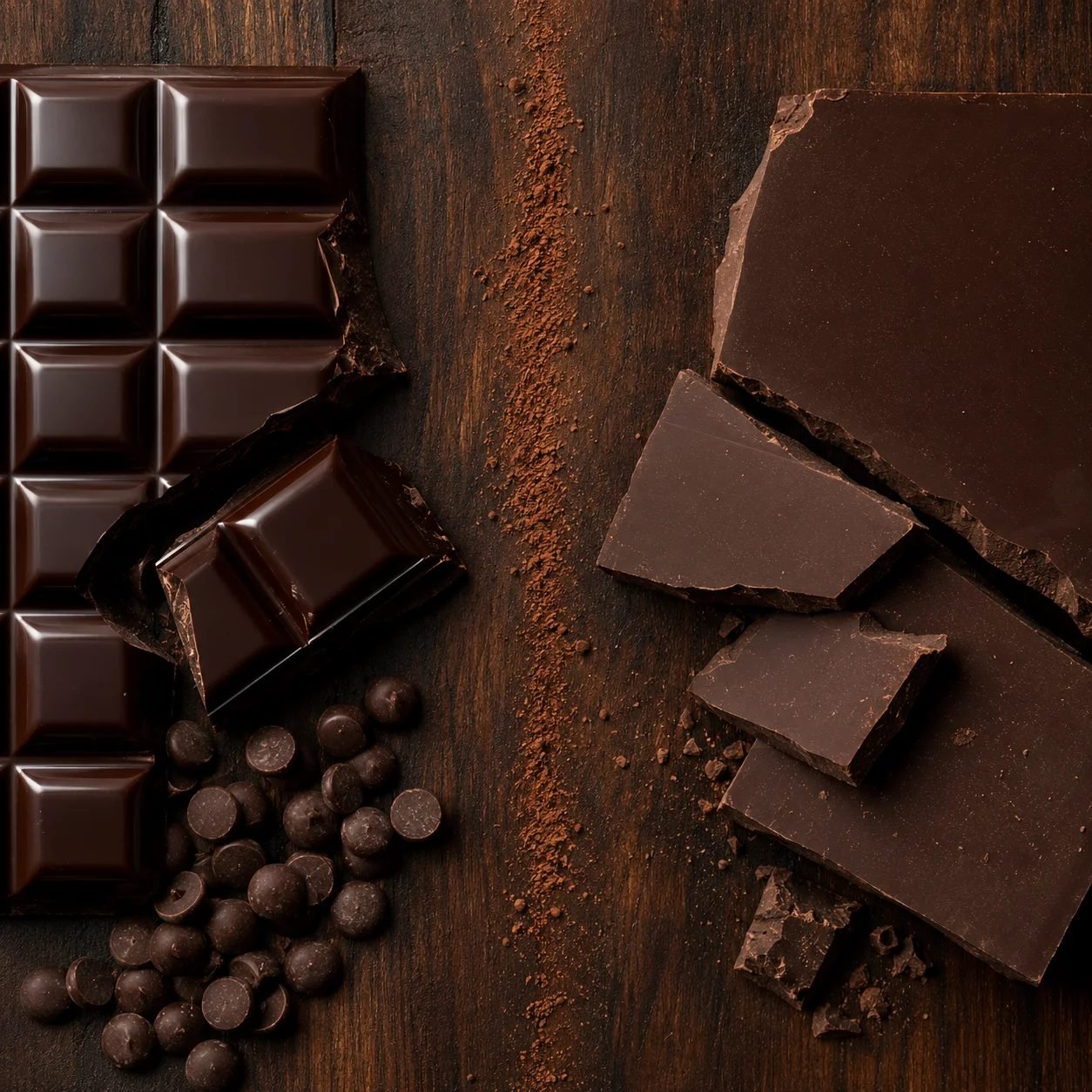
Couverture contains cocoa butter. Compound does not. Compound chocolate replaces cocoa butter with vegetable fat, usually palm kernel or coconut oil.
Everything else follows from that one substitution.
| Couverture | Compound | |
|---|---|---|
| Fat | Cocoa butter | Vegetable fat |
| Needs tempering | Yes | No |
| Melts at | Around body temperature | Higher |
| Flavour | Fuller, more complex | Sweeter, simpler |
| Snap and shine | Excellent when tempered | Adequate, softer look |
| Cost | Higher | Lower |
| Heat stability | Poorer | Better |
Tempering is the real dividing line
Cocoa butter can set into six different crystal structures, and only one of them gives you shine and snap. Getting it there means heating, cooling and reheating within a few degrees. That is tempering.
Get it wrong and the chocolate sets dull, streaky and soft. This is what bakers mean by “bloom”.
Compound has no cocoa butter, so there is nothing to temper. Melt it and use it. That is its whole appeal, and it is not a small one when you are producing at volume in a hot kitchen.
When to use compound
- Coating and drips, where convenience matters more than flavour depth
- Cake decorations that need to hold shape at room temperature
- High-volume work where tempering every batch is not practical
- Summer, particularly for anything that will sit out or travel
- Learning. There is no shame in it. Consistent compound beats badly tempered couverture every time.
When to use couverture
- Ganache, truffles and fillings, where flavour is the point
- Bonbons and moulded work that needs genuine snap and shine
- Anything premium where the customer is paying for quality they can taste
- Air-conditioned kitchens, or winter
The Indian complication
Couverture starts softening around 30 to 32°C. In much of India, that is an ordinary afternoon indoors.
This affects three things. Storage: couverture needs somewhere cool and stable, and repeated warming and cooling causes bloom even in an unopened pack. Working: tempering in a 35°C kitchen is genuinely difficult without air conditioning. Transport: a beautifully tempered couverture cake can arrive with the finish ruined after twenty minutes in a car.
None of that makes couverture wrong. It means you should be deliberate about when you use it.
A practical approach
Many working bakeries use both: couverture where it is tasted, compound where it is seen. A ganache filling made with good couverture inside a compound shell gives you most of the flavour benefit with most of the practical benefit.
If you are choosing one to start with, start with compound, get consistent, then introduce couverture where flavour genuinely justifies the extra work.
How to melt chocolate without ruining it
More chocolate is wasted at the melting stage than anywhere else, and the two ways it goes wrong are both avoidable.
Water is the enemy. A single drop of water or a puff of steam into melted chocolate makes it seize: it goes from fluid to a stiff, dull paste in seconds. If you use a double boiler, the bowl must sit above the water and not touch it, and the water should be barely simmering rather than boiling. Dry the bowl and the spatula before you start.
Heat is the other one. Compound chocolate melts happily up to about 45 to 50 degrees. Couverture is fussier, and milk and white chocolate more so again, because the milk solids in them scorch at temperatures dark chocolate shrugs off.
| Type | Melt to | Notes |
|---|---|---|
| Compound, dark or white | 45 to 50°C | Forgiving. No tempering needed |
| Dark couverture | 45 to 50°C | Then temper if you want snap |
| Milk couverture | 40 to 45°C | Scorches easily |
| White couverture | 40 to 45°C | The least forgiving of all |
In a microwave, work at 50 percent power in 20 second bursts and stir between every one. Chocolate holds its shape well past the point where it has melted inside, so the bowl can look untouched while the centre is already burning. Stirring is how you find out.
If chocolate does seize, it cannot be brought back for coating or moulding. Stirring in a teaspoon of hot water or neutral oil per 100g turns it into a usable sauce or a ganache base, which is a salvage rather than a fix.
Tempering couverture, the short version
Tempering is what puts cocoa butter crystals into the one stable form that gives snap, shine and a clean release from a mould. Untempered couverture sets soft, dull and streaky, which is why people who switch from compound without learning this step often conclude the expensive chocolate was worse.
The seeding method is the one to learn, because it needs no marble slab. Melt two thirds of your chocolate to the temperature above, take it off the heat, then stir in the remaining third, chopped fine, a little at a time. The cool chocolate carries the correct crystal structure and seeds the rest as it drops in temperature.
| Couverture | Melt | Cool to | Work at |
|---|---|---|---|
| Dark | 45 to 50°C | 27 to 28°C | 31 to 32°C |
| Milk | 40 to 45°C | 26 to 27°C | 29 to 30°C |
| White | 40 to 45°C | 26 to 27°C | 28 to 29°C |
Test it by dipping the tip of a palette knife and leaving it five minutes at room temperature. Properly tempered chocolate sets glossy and firm and breaks with a click. If it is still tacky or streaky, it has not taken, and you start again.
This is genuinely harder in an Indian kitchen, because the working temperature you are aiming for is often below the room you are standing in. An air conditioner or an early morning start does more for your tempering than any technique.
Can you make ganache with compound chocolate?
Yes, and plenty of bakeries do, but the ratio has to change and you should know what you are getting.
Couverture emulsifies with cream because cocoa butter and milk fat combine readily. Compound uses vegetable fat, which does not emulsify the same way, so a standard ganache ratio gives you something firmer and, cold, slightly waxy on the palate.
As a starting point, dark couverture ganache is usually built around 2 parts chocolate to 1 part cream by weight. For compound, come down to roughly 1 part chocolate to 1 part cream and expect to adjust. Serve it at room temperature rather than fridge cold, which is where the waxiness shows most.
The cream you use matters as much as the chocolate. Non-dairy cream will not emulsify with either kind properly, so ganache wants real dairy at 30 percent fat or above. Our note on dairy and non-dairy whipping cream covers which is which.
Why chocolate turns white
The white or grey film that appears on stored chocolate is bloom. It is not fungus, it is not spoilage, and it is safe to eat. There are two kinds and they have different causes and different outcomes.
| Fat bloom | Sugar bloom | |
|---|---|---|
| Caused by | Temperature swings | Moisture, condensation, humidity |
| Looks like | Greyish streaks or a soft haze | White speckles, sometimes crystalline |
| Feels | Smooth, slightly greasy | Gritty or rough |
| Fixable? | Yes, re-melt and re-temper | No, texture is permanently changed |
Fat bloom happens when cocoa butter melts and migrates to the surface, then recrystallises in an unstable form. A slab that sat in a warm van, or one moved daily between a fridge and a hot kitchen, will bloom.
Sugar bloom happens when moisture lands on the surface, dissolves some of the sugar, then evaporates and leaves the sugar behind as crystals. Taking chocolate straight out of the fridge into a humid room does exactly this, which is why chocolate that has to be chilled should be brought back to room temperature still sealed in its wrapper.
Either way the chocolate is safe. Fat bloomed chocolate is fine for anything you melt. Sugar bloomed chocolate can go into a bake where texture does not matter, but it will never coat cleanly again. The full storage picture is in our guide to storing baking ingredients in Indian humidity.
Common questions
What is compound chocolate?
Compound chocolate is a chocolate-style product in which the cocoa butter has been replaced with a cheaper vegetable fat, usually palm kernel or hydrogenated oil, alongside cocoa powder or cocoa solids, sugar and milk powder. Because it contains no cocoa butter, it does not need tempering: melt it, use it, and it sets hard and glossy on its own.
What is couverture chocolate?
Couverture is real chocolate with a high cocoa butter content, typically 31 percent or more. That cocoa butter is what gives it the flavour, the melt on the tongue and the snap, and it is also why it has to be tempered to set properly.
What is dark compound chocolate?
Dark compound is compound chocolate made with cocoa powder and no milk solids. It is the workhorse of Indian bakeries: cheap, stable in heat, and reliable for coating, drips and moulded decorations. It tastes noticeably less like chocolate than dark couverture does.
Can you eat compound chocolate directly?
Yes. It is a finished food and perfectly safe to eat as it is. It simply was not designed to be eaten on its own, so the flavour and the way it melts in the mouth are weaker than real chocolate.
How do you make compound chocolate taste better?
Three things help. A pinch of salt per 200g sharpens the cocoa flavour considerably. A spoon of cocoa powder added while melting deepens it. And blending in 20 to 30 percent couverture lifts both flavour and mouthfeel while keeping most of the cost and heat stability advantage, which is the compromise many working bakeries land on.
Does couverture have to be tempered every time?
Only when the set surface will be seen or bitten: coatings, shells, moulded pieces, decorations. For ganache, mousse, fillings and anything baked into a cake, tempering makes no difference and you can simply melt it.
Reading a label
Check the fat. If the ingredients list cocoa butter, it is couverture. If it lists vegetable fat, palm kernel oil or hydrogenated fat, it is compound. Cocoa solids percentage tells you about intensity, not about which type you are holding.
Ivykart supplies these ingredients wholesale to bakeries and home bakers across India, with a GST invoice on every order. Sign up in the app with your phone number and order in minutes. Questions: 8801348400 or care@ivykart.com.