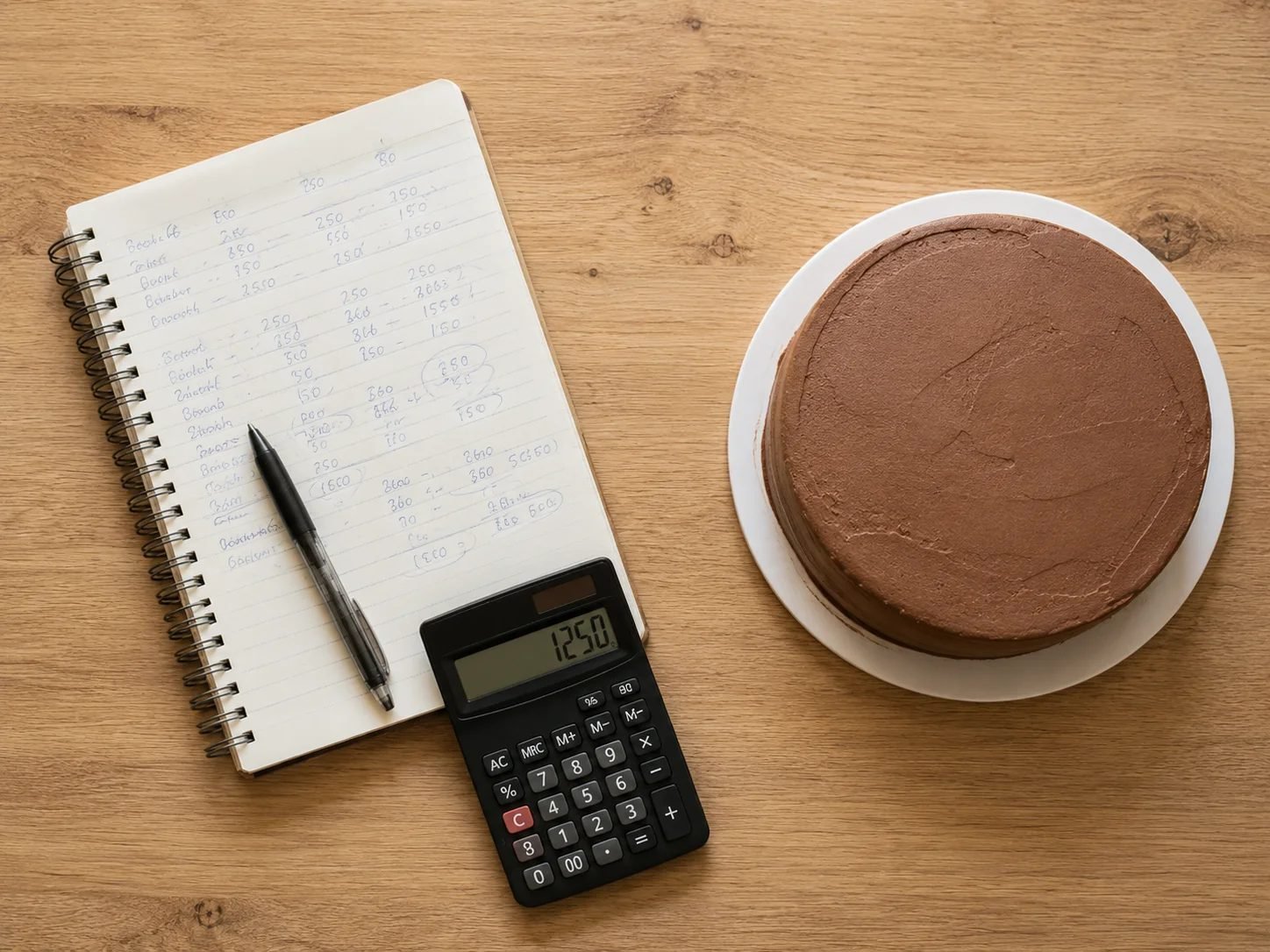
Ask ten home bakers how they price and most will describe the same method: add up the ingredients and multiply by two or three. It feels reasonable. It is also why so many bakers work constantly and never seem to make money.
What that method misses
Four things, and they are not small.
Your labour. If a cake takes four hours including shopping, baking, decorating and cleaning, and you value your time at even ₹150 an hour, that is ₹600. Most pricing counts it as zero.
Packaging. Box, board, insert, ribbon, label. ₹25 to ₹80 per order and almost always forgotten.
Wastage. Trials, failures, the batch that did not set. Five to ten percent of ingredient spend for everyone, however good you are.
Overheads. Electricity for an oven running three hours, gas, water, the equipment that wears out, the internet you take orders on.
A worked example
A one-kilogram chocolate truffle cake.
| Cost | Amount |
|---|---|
| Flour, sugar, eggs, butter, cocoa | ₹180 |
| Cream and couverture for ganache | ₹220 |
| Decoration | ₹60 |
| Ingredient subtotal | ₹460 |
| Wastage at 8% | ₹37 |
| Packaging | ₹55 |
| Overheads, electricity and consumables | ₹60 |
| Labour, 3.5 hours at ₹150 | ₹525 |
| True cost | ₹1,137 |
Priced at the common “ingredients × 3” rule, that cake sells for ₹1,380 and looks like it makes ₹920. It actually makes ₹243, and only if nothing goes wrong.
At a 35% margin on true cost, it should sell at roughly ₹1,750.
The formula
Price = (ingredients + wastage + packaging + overheads + labour) ÷ (1 − margin)
For a 35% margin, divide true cost by 0.65. For 40%, divide by 0.60.
The objection
“My customers will not pay that.”
Some will not. That is useful information, not a reason to work for free. Three things usually happen when bakers price properly:
- They lose the customers who were never profitable. Losing a customer who paid ₹1,380 for a cake that cost ₹1,137 is not a loss.
- They gain time. Fewer orders at proper prices beats more orders at bad ones.
- Nobody notices as much as feared. Someone buying a celebration cake is not price-comparing to the rupee.
Where you can genuinely reduce cost
Not by working for less. By buying better.
Ingredients bought at wholesale rather than supermarket prices typically cut that ₹460 substantially, and the saving repeats on every cake. That is the one lever that improves margin without raising prices or working faster.
Buying packaging in quantity does the same. Fifty boxes cost far less per unit than five.
What the worked example assumes
One thing worth stating plainly, because it changes the numbers. The ₹460 ingredient figure above assumes couverture in the ganache. If you use compound chocolate instead, which most Indian bakeries do, the same cake comes in closer to ₹385.
| 1kg chocolate truffle cake | With couverture | With compound |
|---|---|---|
| Ingredients | ₹460 | ₹385 |
| True cost, all four hidden costs added | ₹1,137 | ₹1,056 |
| Price at 35% margin | ₹1,750 | ₹1,625 |
The point is not which figure is right. It is that a single ingredient decision moves your correct price by ₹125, and if you are pricing from a rule of thumb rather than from your own costs you will never see it. The difference between the two chocolates is covered in our note on compound versus couverture.
Price per kilogram, and why the answer is not one number
Customers ask for a per kilogram rate because that is how bakery shops quote. It is a reasonable question with an awkward answer: your cost per kilogram falls as the cake gets bigger, because labour barely moves.
A 500g cake does not take half the time of a 1kg cake. It takes maybe seventy percent of it. The baking is shorter, the decorating is nearly identical, and the shopping and cleaning are the same.
| Size | Labour | True cost | Price at 35% | Effective per kg |
|---|---|---|---|---|
| 500g | 2.5 hrs | ₹680 | ₹1,050 | ₹2,100 |
| 1kg | 3.5 hrs | ₹1,137 | ₹1,750 | ₹1,750 |
| 2kg | 4.5 hrs | ₹1,850 | ₹2,850 | ₹1,425 |
So a flat per kilogram rate is always wrong somewhere. Set it at the 1kg number and you lose money on every half kilo cake you sell. Set it at the 500g number and you will lose every two kilo order to someone else.
The practical answer is to quote per size rather than per kilogram, and if a customer insists on a rate, quote the rate for the size they actually want. Bakers who move to size-based pricing usually find the small cakes were the ones quietly costing them money all along.
What to charge extra for
These are the jobs that take real time and almost never carry a surcharge.
- Rush orders. Anything inside 48 hours displaces other work and removes your margin for error. Twenty to thirty percent is normal and customers expect it.
- Custom modelling and sculpted work. Price this by the hour, separately from the cake. A figurine can take longer than everything else combined.
- Delivery beyond your normal radius. Fuel, time and the risk of arriving with a damaged cake. Our note on packaging that survives a summer delivery covers the risk side.
- Festival and peak dates. Diwali, Christmas, New Year and Valentine’s are capacity constrained. Pricing at your normal rate on those days means turning away better orders.
- Design revisions after approval. One free change is generous. Three is a job you are doing twice.
Common questions
How much should I charge for a 1kg cake?
Work it from your own costs rather than a market rate. On the example above, a 1kg chocolate truffle cake with a true cost of about ₹1,137 should sell near ₹1,750 at a 35 percent margin. Your figure will differ with your ingredient prices, your hourly rate and your city, but the method is the same.
How do I calculate cake price per kg?
Add ingredients, wastage, packaging, overheads and labour to get true cost, divide by one minus your margin, then divide by the weight. Do it separately for each size you sell, because the per kilogram figure falls as cakes get larger.
What profit margin should a home baker aim for?
Thirty five to forty percent on true cost is a workable target once labour is properly counted. Anything below thirty percent leaves no room for a bad month, a failed batch or an ingredient price rise.
Why does the ingredients times three rule not work?
Because it prices against one cost and ignores four others. On the worked example, ingredients times three gives ₹1,380 against a true cost of ₹1,137, so what looks like a ₹920 profit is actually ₹243, and only if nothing goes wrong.
How do I raise prices without losing customers?
Reprice your three most popular items rather than everything at once, give existing customers notice on their next order rather than at the point of ordering, and change something visible at the same time, better packaging or a finish upgrade. Most bakers find the response is much smaller than they feared.
Three things to do this week
- Time yourself on your next three orders. Honestly, including cleaning. Most bakers underestimate by half.
- Add up one month of ingredient spend and divide by orders. That is your real per-order ingredient cost, wastage included.
- Reprice your three most popular items using the formula. Do not change everything at once.
You do not have to raise prices overnight. But you should know which of your cakes make money and which you are subsidising, and most bakers genuinely do not.
Ivykart supplies these ingredients wholesale to bakeries and home bakers across India, with a GST invoice on every order. Sign up in the app with your phone number and order in minutes. Questions: 8801348400 or care@ivykart.com.